The Suitcase Photo: What Your Packing Day Photos Know About Your Aliyah Story
A phototherapy-informed practice for olim parents and teens, drawn from the Israel Dream Method inside the Israel Dream Journal.
By Lee Uzziah • Israel Dream Lab
Why Your Packing Day Photos Hold the Key to Your Aliyah Story
I watched a mover lift my full-length mirror with one hand. It was the mirror I depended on for complete honesty, scrutinizing every inch of my outfit before rushing out to catch the school bus each morning. It was also the mirror I lip-synced "Uptown Girl" in front of. In my twelve-year-old imagination I was wearing a fabulous outfit, holding hands with a hot Jewish guy in a sports car, traveling the world, having the time of our lives.
Now that mirror was being carelessly lifted from its steady, reliable place of five and a half years by a bulky blond guy with a full beard and a big roll of bubble wrap under his arm. I stared at him with my mouth half open. He needed to know that a precious piece of my identity was teetering upside down in his hands.
"That's really, like, fragile," I explained, when he glanced over the side of the mirror for half a second.
"Oh yeah, don't worry mam, I've got plenty of bubble wrap," he said, nodding at the roll.
I looked past him, down the empty hallway. I could hardly remember what the bare walls looked like when we first moved in here. I had just started first grade, and Zayde had ordered me a new bedroom set. My walls were papered with delicate pink roses. I’m going to miss these walls. My gaze reached the front door. I love this house, I thought, and my eyes filled up for the hundredth time that day. I thought of the picture window in the living room, where I watched cars drive by on the boulevard in rain, shine, and snow. Whenever I thought I recognized a car, I'd get excited and start waving.
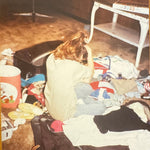
In the 1980s, Mom did most of the documenting, in between a million other tasks. To this day, I don’t know how she did it all. A few photographic relics have survived the decades since: the suitcase photo, the airport departure board with our flight on it, and a borrowed truck loaded with over thirty pieces of luggage.
Somewhere in your own camera roll, or in a shoebox, or on someone's phone, there's probably a photo like this. Most people never look at it again. The long, hair-raising process of aliyah leaves no time for reminiscing on a journey that is still being traveled, no matter how many decades have passed since that fateful El Al flight with all the kids and luggage in tow.
I think about this a lot in my work. Olim couples recall, in detail, the paperwork, the shipping container, the realtor, the lift agent. They describe last dinners with the social and family networks they carefully and lovingly built over the years. They walk me through the logistics of the move without pausing to breathe.
When I ask about the photo, the one taken just before everything started moving, there's almost always a pause. "Let me think… I'm sure I have one somewhere."
That pause is the point of this article.
Why Aliyah Doesn't End at the Airport: Understanding Migration Grief
Thousands of North American olim arrive in Israel every year, hundreds of them as entire families with kids in tow. Behind every one of those arrivals is a home being emptied into suitcases and boxes, doorframes and walls left behind, and a child watching it all happen.
The family therapist Pauline Boss has a name for what many of those families carry: ambiguous loss. It is a loss that stays unclear and can't be officially resolved, so it never quite "closes." Boss describes two kinds: someone physically absent but psychologically present, and someone physically present but psychologically absent. She has said that immigration has ambiguous loss built into it. Even when the move is voluntary, you have left something or someone behind (University of Minnesota).
Family therapist Celia Falicov points out that migration often brings both kinds at once (Cultural Brokering in Schools). The people and places left behind stay vivid in your mind. Meanwhile, the stress of adjusting can leave family members emotionally unavailable to each other, even around the same dinner table.
For olim, even joyful, ideologically motivated ones, this is the actual emotional shape of aliyah:
-
Grandparents who are alive but only visible on a screen.
-
A bedroom that still exists, just not for you.
-
A best friend who is right there in your phone but no longer in your day.
Ambiguous loss doesn't respond well to reassurance ("you'll make new friends!") or to logistics ("we made the right choice"). Boss's approach emphasizes finding meaning, and accepting that a person or place can be both here and gone at the same time.
A photo is unusually good at holding that kind of ambiguity. It doesn't ask you to resolve anything. It just lets you look.
Why Moving Day Photos Matter More Than Memory
You'd think the memory would be enough. You were there, you still remember the room and the feelings vividly.
Since memory reorganizes itself the moment you tell it as a story, by the time you've told your aliyah story a dozen times, it has a familiar shape, with a beginning, a middle, and an end. You already know which parts are going to get sympathetic looks and which parts get knowing nods. Then there are the parts you've quietly edited out. TMI. Keep the story moving.
“The suitcase photo” refers to any of the photos you took on packing day, long before you'd figured out how to tell any of this. Judy Weiser, who founded the modern field of PhotoTherapy, spent decades showing that personal snapshots can reach material that words skip over, the forgotten or defended parts. Her central insight is that the value of a photo goes beyond documentation, into the interaction between you and the image, in the present tense of looking (Weiser, PsicoArt).
Your moving-day photo wasn't composed to mean anything. It wasn't staged for symbolism and layers of meaning. Maybe you took it so future generations would have a relic of the old home. Maybe your hands just needed something to do while the room emptied. Your mind was on the movers, the kids, survival on the other side, and where on earth the family would eat dinner once the kitchen was packed this afternoon.
What I see when I look at my own suitcase photo
I made aliyah going into seventh grade. I don't have many photos from those weeks, not the way people document things now. What exists is a handful of ordinary, slightly blurry shots:
-
My room half packed, the closet doors open and empty on one side.
-
The borrowed truck loaded with luggage at a small midwestern airport.
-
Me walking down our circular driveway with a best friend on each side, on my way to the surprise goodbye party my sixth-grade teacher threw at her house. I had no idea it was coming.
Nobody was thinking about composition. We were all focused on savoring the last moments of the only life we’d ever known, while imagining all the adventure of aliyah would have in store for us.
Looking at these snapshots now, as a mother with grown Sabra kids of my own, I notice things twelve-year-old me had no language for. The room looks smaller once it's empty. I know that's just physics, but it doesn't feel like physics when you're looking at it.
There's also a mark on the doorframe where I used to measure my height. In one photo it's just barely visible in the corner of the frame. I don't think I photographed it on purpose. I photographed the room, and the doorframe happened to be there, holding years of birthdays I wasn't thinking about while I packed.
That's the kind of detail a story skips. If you asked me about leaving at twelve, I'd tell you about the flight, my parents, my fears, and the sadness of leaving bubby and zayde behind. I would never think to mention a pencil mark on a doorframe. But the photo remembers it, it’s part of my story.
A 5-Step Phototherapy Practice for Olim Families
All you’ll need for this is a photo and a few quiet minutes. The five steps follow the same movements I built into the Israel Dream Journal.
1. Histakel (look). Find the photo, and don't rush the finding. If it takes an hour of poring through old albums, let it take an hour. The search is part of the exercise. Once you have it, look without narrating. Most of us jump straight to explaining: "This was the day we left, the movers were late, I was starving because the kitchen was packed." Notice that urge and hold off for at least a minute.
2. Kore (name). Name what's literally in the frame, not the story. What's in focus, what's blurred, what's cut off at the edge? What did you bother to photograph, and what did you walk past? Sometimes what's missing says as much as what's there.
3. Sipur (story). Now let the story in, the version you usually tell. Hold it next to the photo. What does the photo show that your story leaves out?
4. Ta'ir (shine a light). If you stood in that same spot today, camera in hand, what would you frame differently? Not a better photo, a different one, taken by someone who knows how the story turned out.
5. Tze (carry it out). Write one sentence in your journal, next to the photo, or send the photo to yourself on WhatsApp with a one-line caption: What does this photo know that I didn't know yet when I took it? The first honest sentence is usually the right one. Then take it with you into your week.

From Israel Dream Lab
Israel Dream Journal
The five steps above come from the Israel Dream Journal: 48 pages of original art, Jewish text, and photo-based prompts to work through on your own or as a family.
Printed $39 · Digital $28 · Free shipping on every order
Prefer to do it together? Book a one-on-one journaling session with Lee
How to Help Teen Olim Process Migration Grief
Parents often ask me some version of the same question: My kid doesn't want to talk about the move. How do I get them to open up?
My answer is usually that talking was never going to work, at least not directly or head-on. Looking at a photo together sidesteps the part of a conversation that makes kids shut down, the part where they can feel you waiting for a particular answer.
There's research behind this. In studies with refugee families, researchers found that photos give children a safer way into sensitive topics and help build trust, especially when the child has some control over the process (Health Psychology and Behavioral Medicine, 2022). Your child may not be able to answer "How are you feeling about the move?" But they can answer "What do you notice in this picture?"
A few adjustments for kids:
-
Let them find it, or find it with them. Don't hand them a photo you already picked. If they choose it, they own what happens next.
-
Ask questions, not statements. "You must have been so sad" invites them to agree or disagree with your reading of their feelings. "What do you notice first?" invites them to actually look.
-
Brace for silence. Preteens and teens often need longer than adults before they spill their truest thoughts. "I don't know" could just be the pause before they say what they mean.
-
Don't correct their memory. If they remember that day differently than you do, resist the urge to set the record straight. The goal isn't accuracy. It's room for what the photo brings up for them.
-
Follow their lead. Some kids will talk for twenty minutes. Others will say one sentence and be done. Both are complete.
This matters especially at the start of a school year. Israeli research on immigrant adolescents found that their struggles were tied more to migration and cultural adjustment itself than to anything specific their parents were doing (Dwairy & Dor, 2009). So if your child is having a hard year, it isn't evidence that you're doing something wrong. It's evidence that they're digesting something enormous.
Many kids don't have words for that yet, especially when it isn't dramatic, just a low hum of not quite fitting in. A photo gives them something to respond to that isn't a direct question about their feelings. The one-line caption at the end starts to give them those words.
Integrating Phototherapy Into Your Aliyah Journey
This kind of looking works best when it isn't a one-time exercise. That's why collage sits at the center of the Israel Dream Method. One photo can open something up. A collage practice lets you put the suitcase photo next to other found pieces related to your aliyah journey, and start to see a pattern instead of a single frozen moment. As Weiser puts it, a family album's meaning lives in the relationships between the pictures, including what's been left out.
The Israel Dream Journal isn't about making beautiful art, or journaling with pictures instead of words. It's a different way of processing a move this size, one that won't let you skip straight to the tidy dinner-table version.
Sometimes the part the photo shows you is the part you needed to see.
And don’t only save the polished photographs. Keep a few of the messy ones too: the boxes, the empty walls, the picture that wasn't insta worthy. Print a couple of those, to hold on to as well. During a life change as enormous as Aliyah, these photographs become little goalposts. Years from now, they may be the clearest way to look back and see just how far you’ve come.
Try this with me
If you'd like a structured, month-long way to do this with yourself and your family, the Israel Dream Journal is the companion I built for exactly this. It walks through the five movements (Histakel, Kore, Sipur, Ta'ir, Tze), with family editions for younger kids and teens. It's the same method I use in my counseling work with Olim families, laid out for your kitchen table.
And if you try the practice with your own suitcase photo, or with your kids, I'd love to hear what you notice. Especially the part you weren't expecting to find.
Sources
-
Weiser, J. Using Personal Snapshots and Family Photographs as Therapy Tools. PsicoArt.
-
Photo-elicitation study with refugee families (2022). Health Psychology and Behavioral Medicine.
About the Author
Lee Uzziah is a licensed educational counselor in Israel, specializing in phototherapy-informed practices for olim families navigating the emotional transitions of migration. Drawing on her personal experience of making aliyah as a preteen, she founded Israel Dream Lab and created the Israel Dream Method and the Israel Dream Journal to help parents and youth process loss, build resilience, and discover meaning in their journey.